


When two species interact to the benefit of both, biologists speak of “mutualisms.” But nice as these relationships may sound, they are rarely perfectly harmonious — in fact, they can evolve to become unbalanced and exploitative.
Species can cheat or manipulate each other, or downright endanger each other’s health and survival. To stop that from happening, they’ve evolved a variety of mechanisms to control or even punish each other.
Guillaume Chomicki, a biologist at Durham University in the United Kingdom, has been intrigued by mutualisms for years. He specializes in a peculiar group of plants in the genus Squamellaria, members of which grow high in the canopy of tropical trees.
These plants develop mutualistic relationships with species of ants, which provide the plant with food, and sometimes help cultivate it, in return for shelter and snacks. Chomicki has found that Squamellaria plants can prevent cooperation from breaking down by isolating their ant “guests” within physical compartments — and that they are far from the only species doing this.
Chomicki described this and other intriguing examples in the Annual Review of Ecology, Evolution and Systematics, and elaborated in this interview with Knowable Magazine. This discussion has been edited for length and clarity.
How did you end up working on this very peculiar group of exotic plants?
I initially set out to study and classify all plants in a group of about 105 species that live up in the trees where there is no soil, so they depend on ants for nutrients. To do this, I was sequencing DNA from herbarium material, but I was not able to do so for several species that grow in Fiji, so I had to go to there to collect them, sometimes climbing high up into the canopy.
My fieldwork there resulted in a number of discoveries. First, I found that some species are farmed by a particular species of ant: The ant plants seeds on tree branches and then cultivates the plants, by fertilizing and defending them from herbivores, and finally harvests them, too. We knew of ants farming fungus, but this was something different.
These plants grow large chambers in which the ants make their nests, and the ants’ excrement provides the plant with nutrients. They always associate with the same species of ant, but as I found out later, others don’t. Once, I cut open the chamber of another plant species and discovered two completely different ant species inside — a small one and a big one.
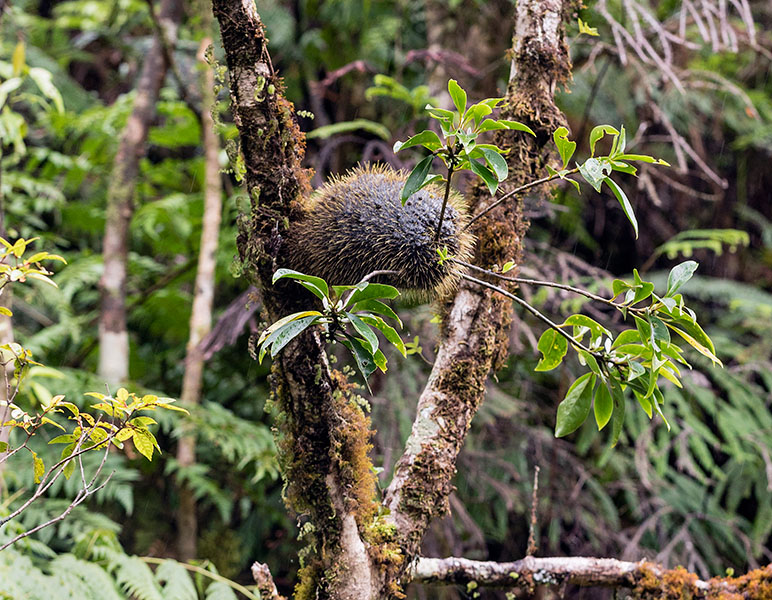
Because this Squamellaria wilsonii plant (and related species) grows high up, attached to trees, it can’t get nutrients from the soil. Instead, it depends on ants that live in specially evolved chambers on the plant.
CREDIT: JOHN GAME / FLICKR
I found that very odd. Basically, all theories have predicted that multiple, unrelated cooperation partners would be a bad idea. Bad partners could be allowed to survive because you also have good ones, and competition between partners could lead to the destabilization and ultimately the breakdown of the association. So I wanted to understand why this can exist.
I then found many more examples of this — the maximum was five different species of ants living in one plant. So I did a wide range of experiments to understand what was going on. The first possibility was that these ant species were simply not very aggressive. To test this, I took workers from one of the species of ants and put them near workers of the other species to see whether there would be conflicts. And yes, there were. But what was interesting was that in field lab experiments, when you kept the nests apart, the ants could share a nearby sugar source without killing each other.
This gave me the idea of CT-scanning the structures. This way, I discovered that while all the plants associating with just one ant species had one big compartment, all the ones hosting multiple ant species had multiple compartments. These were all independently connected to the outside world but were never connected between one another.
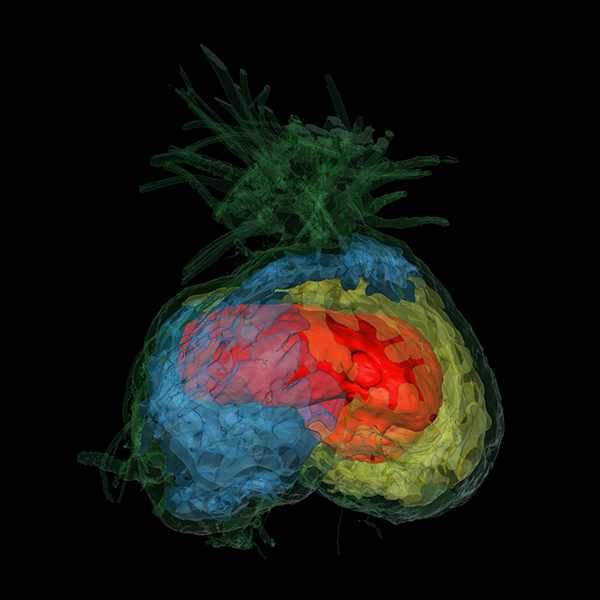
A CT scan clearly reveals the different compartments in Squamellaria tenuiflora that allow it to peacefully host multiple ant species at the same time.
CREDIT: G. CHOMICKI AND S. RENNER
The ultimate test was to disrupt these compartments. When I removed the wall between two different species of ants, I found they would fight to death. After half an hour, few ants would be left alive, even though they’d been living there for years. The plant suddenly ended up without any ants at all.
Why would some plants host multiple species whereas others only host one?
The specialist plants that host and are farmed by one species of ant all descended from ancestors that were generalists — they hosted various species. The Philidris ants that farm and live within Squamellaria plants that host only one species of ant have a very particular trait: They can make satellite nests, which means they can inhabit many Squamellaria plants within the same tree. In doing so, they can create huge colonies, which are very hard to take over.
They’re also very aggressive, which forces other ants to stay away. That may have created a situation in which plants evolved to specialize on hosting this particular species of ant.
This has clear benefits to the ants, since they no longer have to compete. But specialist plants also tend to benefit more from hosting their favorite ants. We’ve found they receive about 2.5 times more nitrogen from them than generalists get from their ants. But because they depend on one particular ant species, they are more vulnerable, and now are often endangered, too.
On Fiji, there is an invasive ant species — the white-footed ant — that sometimes replaces Philidris colonies. Within six months, the plant dies. That cannot happen to generalist plants, because they benefit from any species of ant, including the invasive one.
Some Squamellaria plants host multiple species of mutualistic ants, their chambers separated by walls and with separate entrances to the exterior. When the walls were removed between compartments hosting Camponotus polynesicus (orange) and Camponotus sadinus (black), deadly violence ensued.
CREDIT: G. CHOMICKI ET AL / SCIENCE 2025
Are these compartments that allow multiple species to live inside the plant at the same time a unique feature of Squamellaria, or did other species evolve similar solutions?
They are rather unique, though species that have bacterial symbionts — humans included — do promote the growth of different bacteria in different areas of the body, which is arguably a kind of compartmentalization. Bodies also have mechanisms to prevent bacteria from entering areas where they can cause disease. When otherwise beneficial skin or gut bacteria enter our bloodstream, for example, they can become very dangerous. This shows that mutualism is always a matter of balance and control.
Many plant roots have similar protections to prevent the fungi that help them absorb nitrogen and phosphorus from growing too far inside, where they can cause damage. They also often host different strains of bacteria or fungi in different compartments, so they can selectively reward or punish them based on what they contribute.
The bobtail squid does something similar with the crypts in which it hosts different strains of luminescent bacteria that help it hunt at night, by gradually flushing out the strains that are no longer making light. Corals also impose strict limits on their symbionts to make sure they don’t grow too numerous.
And plants that allow insects such as fig wasps or yucca moths to lay eggs on them in exchange for pollination may control the number of eggs that are laid, by aborting fruits or flowers with too many eggs. There has been some debate over whether this is a specific adaptation or simply the result of a preexisting plant response to herbivory damage caused by too many eggs, but in any case, it’s effectively a sanction.
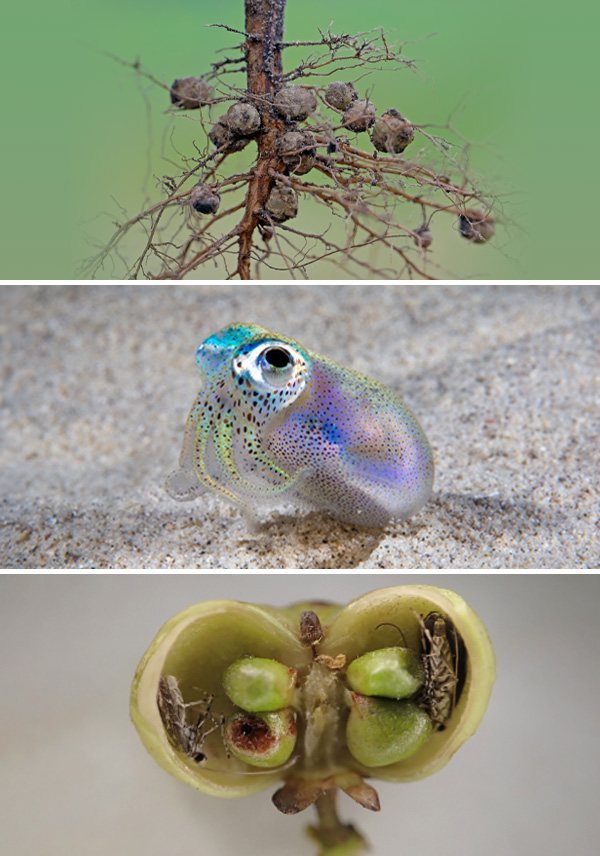
Compartments play a crucial role in cooperation for a variety of species, not just Squamellaria plants. For example: Soybean plants host different nitrogen-fixing bacteria in different root nodules (top) so they can reward those that provide plenty of nutrients and restrict the ones that don’t. The Hawaiian bobtail squid (middle) does something similar with the luminescent bacteria it houses in crypts inside its body. And fig trees can drop flowers containing moths that eat too many seeds or don’t pollinate enough.
CREDITS FROM TOP: ISTOCK.COM / TOMASZ KLEJDYSZ, ROBJ808 / SHUTTERSTOCK, SHI-XIAO LUO ET AL / THE AMERICAN NATURALIST 2017
In the symbioses between plants and specific ants, the food the plant provides will often only be accessible for the ant species they associate with. We have done experiments showing that only Philidris ants can bite through the thick layer surrounding the Squamellaria plant’s nutritious nectaries to access the sugary liquid within. Similarly, acacia ants in Central America are the only ones that can feed on the protein- and lipid-rich outgrowths on the leaf tips of the tree species they protect, live and feed on.
These acacias are quite notorious for another reason: The nectar they provide contains an enzyme that makes it harder for the ants to digest the nectar of other plants.
Yes, the nectar contains an enzyme, chitinase, that makes the ant’s invertase, a sucrose-cleaving enzyme, inefficient. This essentially forces the ant to feed on the acacia’s nectar, which is poor in sucrose, rather than foraging on other nectars.
Another example is the caterpillars of gossamer-winged butterflies, many of which live in ant nests. They drug the ants to alter their behavior. There are several such cases of apparently abusive behavior, where dependence is inflicted by one partner onto the other.
Some hosts trick symbionts into dependence, but many times the dependence just evolves over time.
That’s right. If we think of, for example, the symbiosis between aphids and Buchnera bacteria, which live inside cells of the aphid, the bacterial genome has become so small it can’t do anything on its own. In many cases, these symbionts eventually accumulate so many harmful mutations that they become useless to the host, no longer providing the nutrients they used to, and have to be replaced. You see this again and again in insects. Even though we cannot test how fit the partners really are on their own, this doesn’t look very good for the symbiont, and it becomes more exploitative than it would need to be.
I think this is the major pathway to evolution of obligate dependence in which species really depend on each other for survival. Both species might lose the ability to perform certain functions, say digesting certain nutrients, producing certain vitamins or defending themselves from predators, because they are provided by the partner. It’s an automatic evolutionary mechanism that makes species dependent — and vulnerable. When one species goes extinct, the other one is likely to disappear as well.

How would you classify our own relationship with the plants and animals we’ve domesticated?
When we think about domestication, there are cases which I would call exploitative. In some major plant crops and domesticated animals, you have such an accumulation of harmful mutations that they cannot survive or reproduce without us. There are chickens that put on so much meat that their bones would break before they’re able to reproduce. There are similar examples in plant crops too. They can’t disperse their seeds, they depend on humans to reproduce, and their genetic diversity has eroded.
On the other hand, of course, these plants and animals are now among the most abundant on the planet. It’s a complicated relationship.