


The enduring allure of conspiracies
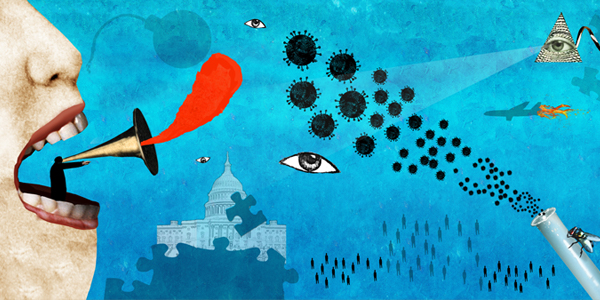
By Greg Miller Conspiracy theories seem to meet psychological needs and can be almost impossible to eradicate. One remedy: Keep them from taking root in the first place. Read more.
The Knowable podcast — Season 1
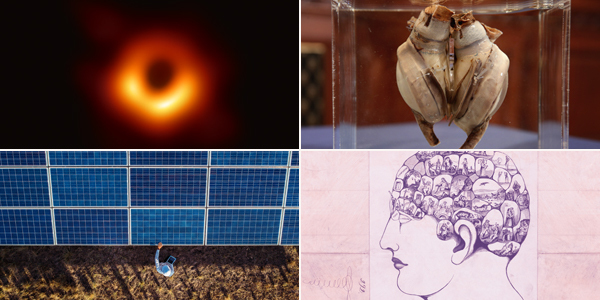
What are the limits to what’s knowable — and how does our thinking about big questions in science and technology evolve over time? Take an audio journey that explores the research and innovations that have broken new ground in science and society.
Episode 1: How black holes morphed from theory to reality
Episode 2: The heart of invention
Episode 3: The dazzling history of solar power
Episode 4: Memory, the mystery

Don’t abandon paid sick leave. It’s a cost-effective tool against Covid-19
By Stefan Pichler and Nicolas R. Ziebarth OPINION: Requiring companies to give unwell workers compensated time off isn’t a burden. It’s smart public health policy that reduces the spread of disease. Read more.
ICYMI: Last week’s online event
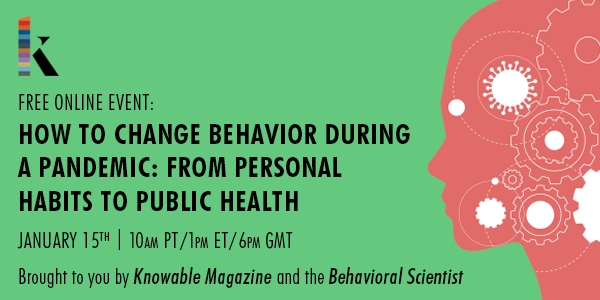
How to change behavior during a pandemic: From personal habits to public health
VIDEO: It’s not too late! Watch the conversation with behavioral scientist Katherine Milkman and social neuroscientist Jay Van Bavel about hurdles and strategies for enacting behaviors that help combat the spread of Covid-19 and for achieving personal goals in the coming year. Watch now.
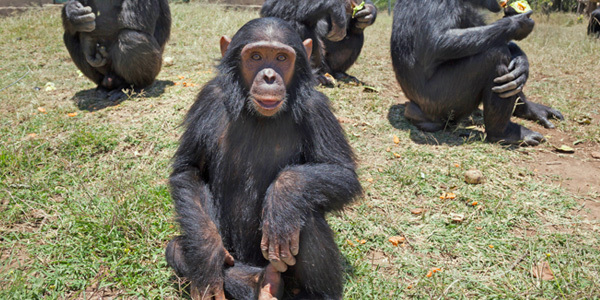
Protecting great apes from the unknown effects of Covid-19
By Jackie Rocheleau At least two gorillas at the San Diego Zoo Safari Park have tested positive for the coronavirus, the first known instances of infection in great apes, Jonathan Wosen reports for the San Diego Union-Tribune. Read up on measures sanctuaries have been taking to protect our primate cousins from the virus. Read more.
RESET: The Expert Take
Changing behaviors and minds When the pandemic came to Ireland, Pete Lunn dropped everything. For years, his behavioral economy team at the Economic and Social Research Institute in Dublin has been testing policies and interventions designed to help people make better decisions. With a potentially deadly virus rapidly spreading through homes, schools and workplaces, understanding how to influence human behavior had never felt so important.
“We just decided to try to review the evidence as quickly as we could and get behavioral research into the public domain and the hands of government to say, ‘Look, you know you need to pay attention to this — it’ll help you,’” Lunn says.
By mid-March of last year, Lunn’s team had published a review of behavioral science research that might inform public policies aimed at curbing the spread of Covid-19. They began testing pandemic-related interventions, such as contact-tracing apps and education campaigns encouraging vaccination. Some of their insights are simple: Placing sanitizing stations in the middle of a lobby where they catch people’s attention, for example, is better than sticking them in a corner where they’re not as noticeable. But others are less obvious. In one experiment, Lunn’s team found that posters emphasizing the mathematics of exponential spread — one person infecting three people, who may infect nine, and then 27 — were particularly effective in encouraging people to make safer plans.
If we want to encourage our friends and relatives to stay safe, Lunn suggests appealing to a sense of cooperation and shared interest. When discussing risk, name real people you want to protect: Invoking a grandparent or neighbor who’s known and loved is more powerful than referencing an abstract population.
What we’re reading
Tracking the virus
The irrational, rationalized The pandemic has disrupted all aspects of normal life, and for many who struggle with germ-phobia-related obsessive compulsive disorder, that includes years of therapy. It’s one thing to tackle obsessive behavior when it’s at odds with the people and environments around you. But what do you do when your fixation with handwashing and avoiding physical contact becomes the norm? Gabrielle Glaser explores the question for STAT News.
Emission omission American greenhouse gas emissions fell 10 percent in 2020, putting the US on track to meet the Paris climate agreement. But this may be no cause for celebration: The drop in emissions stems from the effects of the pandemic, not any purposeful change, writes Benjamin Storrow for E&E News. Without dedicated action from the government, experts expect 2021 emissions to climb right back up again. Here’s the (unpaywalled) version at Scientific American.
Distract yourself with science
All shook up Over a century ago, a meteorologist had a crazy notion: What if Earth’s landmasses were moving? Some found it intriguing, others mocked the idea. Today, plate tectonics — which describes Earth’s surface as interlocking rocky slabs floating atop a molten sea — is a unifying geological framework that explains the creation of mountains and seafloors, as well as earthquakes and volcanos. At Science News, Carolyn Gramling details the decades of toil that took plate tectonics from a germ of an idea to a fundamental tenet of understanding our planet.
FM for fishermen Born from a desire to keep fishermen safe in rough weather, a grassroots radio station in India now curates its content to serve fishing families, an effort that also aids the waters they rely on. The small station covers issues from plastic pollution to overfishing, writes Kamala Thiagarajan in Hakai, and by letting the locals do the talking, the station has built trust and community. Coverage is not all doom and gloom: Discussions about serious problems are punctuated by cooking tips, opportunities for students and the occasional poetry reading.
Art & science
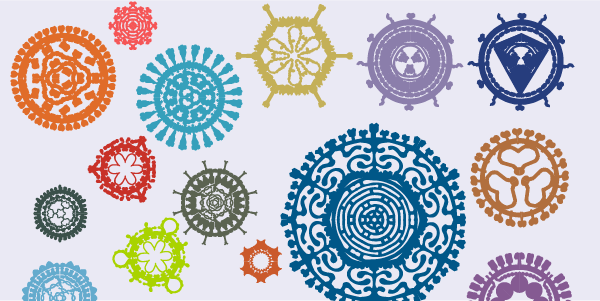
CREDIT: ED HUTCHINSON/MRC-UNIVERSITY OF GLASGOW CENTRE FOR VIRUS RESEARCH
Paper pathogens Look closely at these paper cutouts and you might recognize the all-too-familiar spike protein that studs the surface of the SARS-CoV-2 virus (turquoise, top center-left). Inspired by traditional paper snowflake decorations, Ed Hutchinson of the MRC-University of Glasgow Centre for Virus Research created a collection of virus snowflakes, complete with templates for making them yourself. “One of the things that makes virus particles beautiful is that they are often symmetrical,” Hutchinson explains. “Indeed, some virus particles are so regular that, like the water that forms snowflakes, they will assemble into crystals if they are kept under the right conditions in a laboratory.”
The collection includes herpes simplex virus (large dark blue, center right), hepatitis C (light green, lower left) and both immature and mature HIV (light purple and dark blue respectively, top right). If you can’t quite get behind crafting with the Covid-19 virus, there’s also a coronavirus that’s been neutralized by antibodies and a Covid-19 RNA vaccine. Happy cutting.