




Many mangrove restorations fail. Is there a better way?
By Katarina Zimmer These carbon-hoarding, coastline-protecting forests are sponges for greenhouse gases. Doing plantings right and involving local communities are key to saving them. Read more.
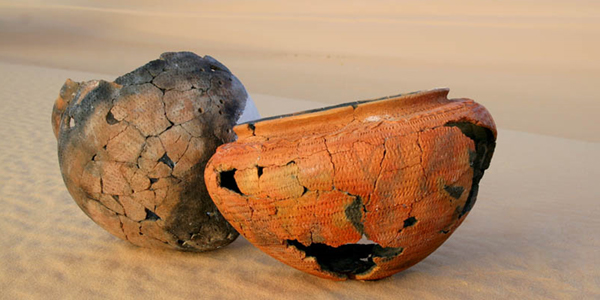
What did ancient people eat? Scientists find new clues in old pottery
By Carolyn Wilke Remnants of molecules and microbes in shards of cooking pots help researchers reconstruct prehistoric cuisines. On the menu: stews, cheese and fermented drinks. Read more.
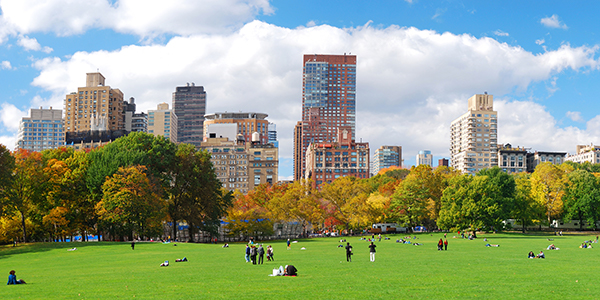
Covid cut pollution and got us outside. Let's keep it up.
By Ebba Malmqvist OPINION: Urban planners need to find ways to reduce traffic and provide equal access to green spaces. Read more.
Educators: We need to hear from you. Knowable Magazine is conducting a survey to learn more about how we can help teachers with lesson planning, course materials and more. Please take this 8-minute survey to show us how we can help. (As a thank you, we'll enter you in a free prize drawing for an iPad.)
Share with your friends and colleagues to help us spread the word! Start now.
From the archives
There’s no silver bullet for fighting vaccine hesitancy, argues Heidi Larson, founder of the Vaccine Confidence Project. In a New Yorker profile by primary care physician Danielle Ofri, Larson urges us to view vaccine rumors as an ecosystem, akin to the microbiome. “Tackling misperceptions individually is like eliminating a single microbial strain: When one germ is gone, another will bloom. Instead, the entire ecosystem must be rehabilitated.”
See our story for more on what’s been learned about improving vaccination rates, or watch our conversation with two experts in behavior change.

How to change behavior during a pandemic: From personal habits to public health
VIDEO: Watch our conversation about the science of behavior change — from public health tools to slow the pandemic to keeping New Year’s resolutions. Watch now.
What we're reading
A is to B as . . . Show a deep neural network millions of pictures of bridges, and it will recognize a bridge in a picture it’s never seen. But then ask it about “bridging the gender gap,” says artificial intelligence researcher Melanie Mitchell, and it will figuratively throw up its hands. That’s because AI is terrible at analogy, a skill that’s crucial for conquering real-world problems. In a Q&A with John Pavlus at Quanta Magazine, Mitchell discusses various efforts to teach analogies to AI systems, why many such efforts have failed and whether having a physical body may be part of the secret sauce. (Learn more from Mitchell in our story).
Brisk breeding Fire blight is a nasty infection that can ruin entire apple orchards. While breeding genes from wild, blight-resistant relatives into apple varieties that we eat holds promise, it presents another problem, writes James Dinneen at the Counter. “Apple trees are trees.” Trees mature so slowly that it can take upwards of 40 years to bring the fruits of breeding experiments to market. But a new approach called rapid cycle breeding, which borrows a fast-flowering gene from a birch tree, may trim years off that timeline and could help fight ills that strike other orchard trees, like citrus and nuts. (And see our piece on fighting tree epidemics.)
At long last Gun violence is a leading cause of death each year in the United States, but for decades funding of firearms research has been “anemic,” Nidhi Subbaraman reports for Nature. Now, spurred by tragedies including the shootings at Sandy Hook Elementary School in Newtown, Connecticut, and at the Marjory Stoneman Douglas High School in Parkland, Florida, lawmakers have allocated research dollars specifically to study gun violence as a public health issue. Projects receiving funding include investigating efforts that could reduce firearm suicides and prepare parents to prevent gun accidents at home. But many say that the $25 million provided each of the last two years is just a drop in the bucket compared with what’s needed to fill the knowledge gap left by decades of little research at all.
Art & science
CREDIT: Cornell University
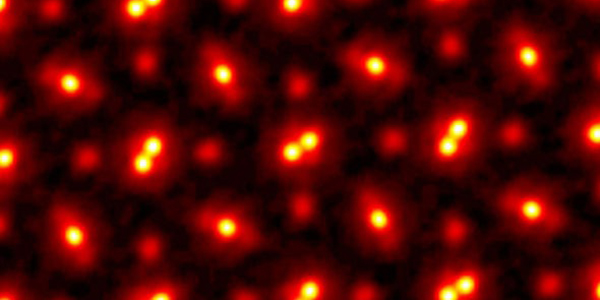
Atomic portrait These atoms are ready for their close-up. In the highest-resolution image ever obtained, Cornell University researchers visualized the positions, orientations and shapes of individual atoms — yes, atoms — in a crystal of praseodymium orthoscandate. The view magnifies the crystal’s innards about 100 million times, Anna Blaustein writes at Scientific American. For reference, that’s like inflating a soccer ball to about the size of Earth.
To obtain the image, the researchers fired electrons — about a billion per second — at the crystal. Some electrons sailed through it, while others ricocheted off the atoms. State-of-the-art detectors precisely recorded the ensuing electron spray, which a machine-learning algorithm used to deduce the atomic architecture of the crystal. The image is so high-res that the blurring you see is the just the thermal jiggling of the atoms themselves.