


A hand touches a scalding hot plate, sharp pain erupts and immediately, the body gets to work. Damaged cells send out distress signals; immune cells rush in. As inflammation subsides, a coordinated repair process begins. Eventually, collagen fibers aligned in tight parallel rows will replace much of the damaged tissue. The wound heals, but it does not resemble normal skin.
For a small burn or cut, a scar is a small price to pay for rapid healing that mitigates the risk of infection. But in larger burn wounds, scarring can be devastating.
Each year, 11 million people require hospital care for burns. Long after the wounds have healed, scarring can cause complications. Unlike the random, basket-weave pattern that makes normal skin flexible and resilient, scar tissue tightens as it heals and, once mature, grows more slowly than surrounding skin. This can hinder movement and, in children with extensive burns, interfere with normal growth and development. Severe scars often lack hair follicles, sweat glands and nerve endings, reducing the ability to experience touch and to regulate body temperature.
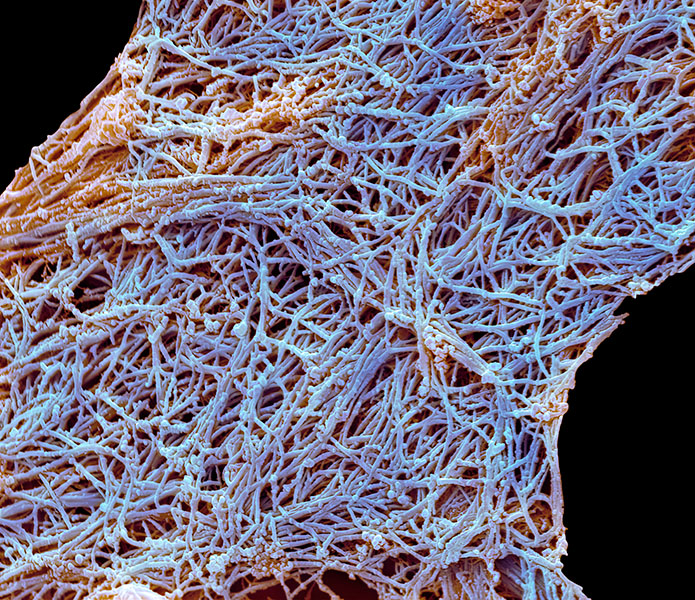
Normal skin contains collagen fibers that grow in a random basket-weave pattern shown here, while in scar tissue collagen fibers typically grow parallel to each other.
CREDIT: STEVE GSCHMEISSNER / SCIENCE SOURCE
Scientists have long tried to develop ways to nudge the body to build healthy tissue instead of defaulting to emergency repair. In recent years, 3D bioprinting technology has emerged as one of the most promising approaches. By depositing patients’ own, pre-cultured skin cells suspended in an ink-like gel, these printers can create personalized skin substitutes, kickstarting the regeneration process. While it is early days, the technology is coming closer to clinical reality.
The key is accessing the body’s ability to rebuild, says wound healing researcher Johan Junker of Linköping University in Sweden. Our bodies, he says, “have been practicing this for millions of years, and we do it constantly, because our skin and every tissue in our body, more or less, always turns over. So why not just provide as good a set of building blocks as we can and then let nature do its thing?”
Inks made of cells
For nearly a century, the gold standard for closing severe burn wounds has been split-thickness skin grafts. Surgeons remove the outermost layer of skin, the epidermis, and a sliver of the underlayer, the dermis, from an unburned part of the patient’s body, and use it to cover the wound.
But in cases of extensive burns, there may not always be enough healthy skin to graft. And while this approach improves healing and aesthetics, it doesn’t eliminate scarring, since much of the skin’s functionality resides in the dermis, which has been replaced only in part. (Harvesting skin from other parts of the body can introduce scarring there, too.)
Personalized skin substitutes created using traditional culture methods — multiplying cells in a lab dish, then layering them into a premade gel scaffold — have recently shown that scarless healing is possible: A product called denovoSkin, which replaces the dermis as well as the epidermis, has been used to treat children with severe burns in compassionate use cases. However, this approach requires special laboratory facilities and takes several weeks, which matters since the longer a wound remains open, the worse the risk of scarring. And the more severe the wound, the harder it is to build a viable three-dimensional skin substitute.
Bioprinting offers a way around some of these challenges, and a variety of research groups are working to find an optimal formula for the “ink” of such printable skin.
The severe wounds such technologies could treat are an overlooked health burden, says Hafiza Parkar, a regenerative medicine researcher at the University of Pretoria in South Africa, who is developing a 3D bioprinted skin substitute. Wound healing affects every single part of medicine, Parkar says, and the burden falls hardest on low- and middle-income countries.
In Sweden, Junker, with colleague materials scientist Daniel Aili and others, recently designed a bioink that could improve healing, which has been dubbed “skin in a syringe.” They began with fibroblasts — the main cells of skin’s middle layer, the dermis — collected from abdominal skin from tummy tuck procedures, and then grew the cells on porous gelatin beads in a bioreactor. Fibroblasts produce proteins that form the skin’s scaffolding, and release growth factors that dampen inflammation, helping to promote healing. In three days, the team found, the cells had formed dense microtissues.
The scientists then added microbeads laden with these cells to hyaluronic acid, which will serve as the bioink hydrogel base that holds everything together. Naturally occurring in the body, this water-binding molecule comprises molecular chains that, with a bit of chemistry, will cross-link, forming a firm gel akin to skin’s natural scaffolding. Usefully, it liquefies under pressure, behaving like ink as it passes through a syringe or printing nozzle.
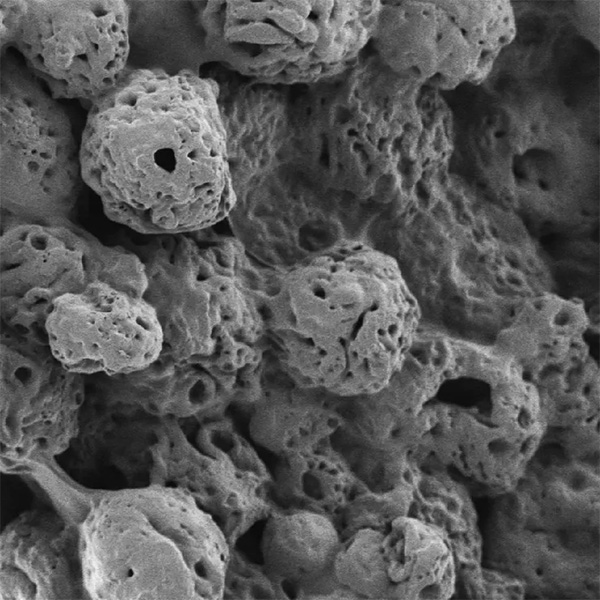
Spheres of gelatin are seeded with skin cells and then mixed with a water-binding gel to yield “skin in a syringe,” shown here in a scanning electron microscope image.
CREDIT: COURTESY OF LINKÖPING UNIVERSITY
Tests in which the bioprinted skin construct was implanted beneath the skin of mice showed that the cells survived printing and began forming healthy dermal tissue, a promising, albeit early, sign for scarless healing.
“We’re kind of tricking the cells in the wound,” Junker says. “Instead of ‘Oh no, I’m in a huge wound, this is horrible, I need to scar it up as fast as I can,’ tricking it into more of a ‘Oh OK, it’s time for me to do my regular thing and just turn over tissue and regenerate, as I always do.’”
The team is now testing the bioink in pigs, whose skin and wound-healing processes closely resemble those of humans, before moving to clinical trials, which will reveal more about its ability to diminish scarring. Once it reaches the clinic, the bioink will likely be applied via syringe, says Junker. However, bedside robotic printing arms are on the horizon.

Printing precisely
In Sydney, Australia, one such robotic printer called LIGŌ has just undergone a clinical trial, making it the first to be tested in people. Developed by biotechnology company Inventia Life Science, LIGŌ is designed to map a patient’s wound and print a precisely matched construct directly into it, nanoliter by nanoliter.
“All we’re doing is structurally placing cells in the correct position to help the body reach that healing capacity and reinstate the integrity of skin,” says burn surgeon scientist and study lead Joanneke Maitz. “Instead of using an incubator in a laboratory, the body itself almost functions as the incubator.”
For simplicity, Maitz and her colleagues printed onto the donor sites — the wounds left behind where participants’ skin was removed for grafting — rather than the burns themselves. They used only epidermal cells, the skin’s top layer, harvested from a biopsy during the same operation. Participants reported less pain at the sites treated with LIGŌ than those treated with regular dressings, and the trial, reported in the Journal of Burn Care and Research, confirmed that the treatment had no adverse effects. In the next phase, the team will compare scarring outcomes.
Although printing directly into a wound has the advantage of faster deployment, building a three-layered construct directly at wound sites remains, for now, a challenge.
Bench-top bioprinters get around this by working outside the body under controlled conditions. Regenerative medicine expert Anthony Atala and his team at the Wake Forest Institute for Regenerative Medicine in Winston-Salem, North Carolina, are using that approach. They are creating a full-thickness skin substitute that uses cells from all three of the skin’s layers. Their construct might help with the most severe wounds by replacing elements of even the deepest skin layer, the hypodermis, which normally supports the healing of shallower tissue. The trade-off is that cells must be cultured for three to four weeks before the substitute skin is printed and applied to the wound.
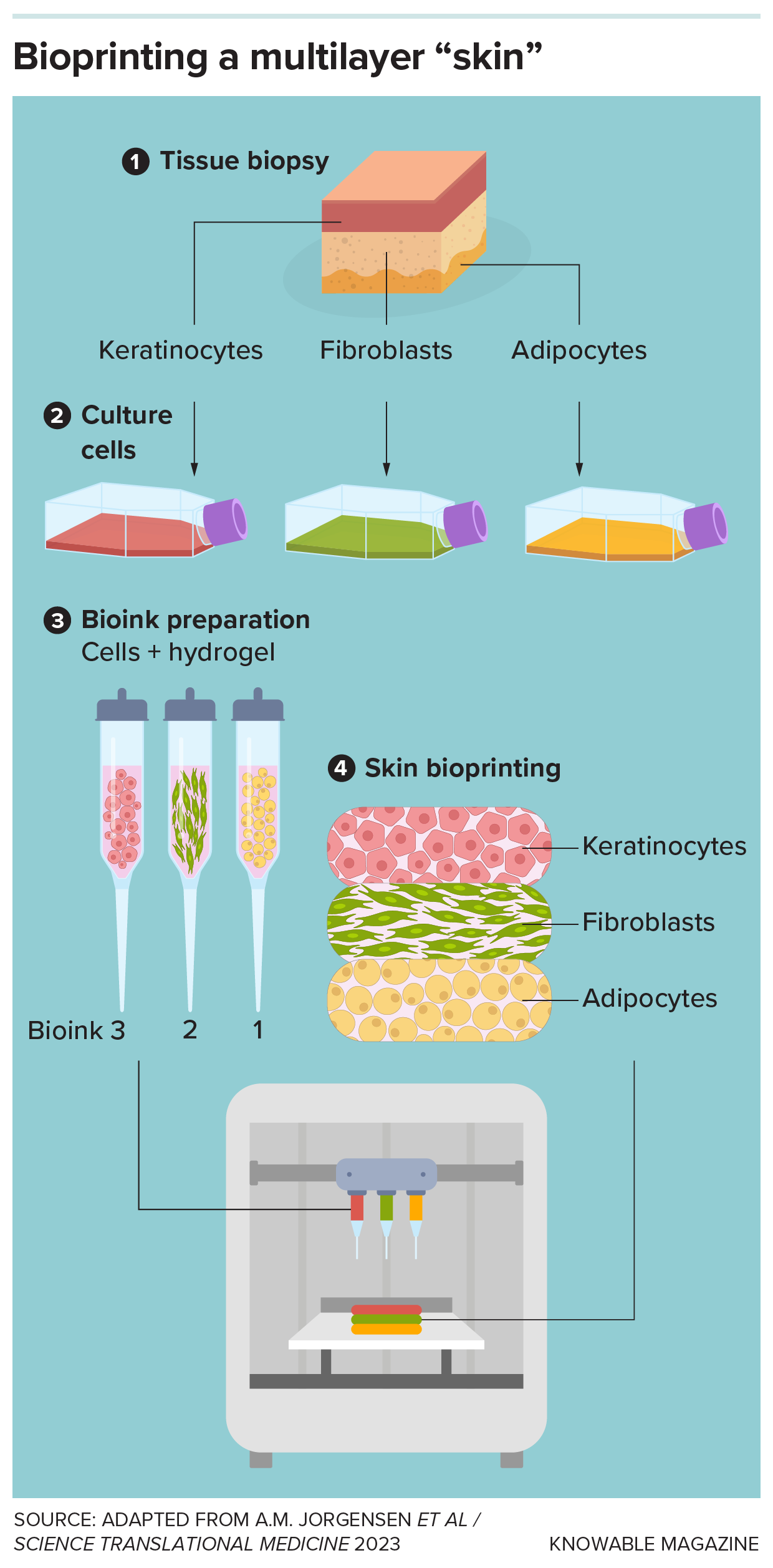
The basics of printing skin substitutes include harvesting cells, culturing those cells, creating an ink and printing the “skin.” In this simplified graphic, cells from three different skin layers are used. Some approaches use cells from only one skin layer, while others add additional cell types, such as follicle cells for hair, melanocytes for pigment and endothelial cells for blood vessels.
Atala says that automating the creation of skin substitutes through 3D bioprinting could help make them more cost-effective. “What the printer does, is it gives you scalability,” he says. “You can reproduce the technology … at the same time, over and over again."
The team tested in mice a three-layer skin substitute that used all six of the main human cell types found in skin (cells from the three skin layers and for hair follicles, blood vessels and pigment). The substitute encouraged rapid healing, and normal-looking skin, the team reported in Science Translational Medicine. They also recorded blood-vessel regrowth, a major challenge in skin substitute research.
In pigs, wounds treated with a similar skin substitute (using the four main pig skin cells) healed with a basket-weave structure, contrasting with the scarring and greater contraction of those treated with just hydrogel or a skin substitute made with non-personalized cells. The substitute-treated wounds also produced more healing-promoting molecules and fewer scar-driving ones. The team is now fine-tuning the manufacturing process before running clinical trials.
For 3D bioprinted skin substitutes to work as hoped in severe wounds, the body will need to assemble the inks’ cellular building blocks into new blood vessels, nerves and hair follicles, something no construct has yet achieved. But Atala’s pig results, showing blood vessel regrowth and reduced scarring, suggest that the field is moving in the right direction.
Upcoming trials and future studies using different bioinks will reveal whether researchers can harness the body’s own regenerative capacity to achieve scarless healing and perhaps change the gold standard of care for burn survivors.