

LAYOUT MENU

To heal stubborn wounds, scientists look to nanomaterials
Slow-healing lesions — common in diabetics and burn victims — can lead to lingering infections that resist antibiotic treatment. A new approach using light-activated therapies may offer a solution.
Support sound science and smart stories
Help us make scientific knowledge accessible to all
Donate today
For most people, a minor cut or scrape is no big deal — the body heals itself quickly, and antibiotics can deal with any infections. But some wounds, such as severe burns and diabetic ulcers, are prone to bacterial infections that can become resistant to antibiotics.
“Diabetic wounds are very difficult to heal and people live with these wounds for pretty much the rest of their life,” says Vitaliy Khutoryanskiy, a materials scientist at the University of Reading in the United Kingdom.
To address this problem, scientists are developing new ways to treat infected wounds using specially designed nanomaterials that are activated with light and deliver precise antimicrobial action. The approach has shown promise in reducing infection and accelerating wound healing in experiments on mice and pigs but has not yet been tested in people.
Chronic, non-healing wounds offer ideal conditions for the formation of resilient biofilms, which delay healing and significantly raise the risk of amputation. The vast majority of such wounds — over 78 percent — have these stubborn layers of bacteria, which are often antibiotic-resistant.
The new light-activated nanomaterials offer a different way to eradicate bacterial infections, by converting light into localized heat, or by reacting with oxygen present in the tissues to produce toxic molecules that kill bacteria with minimal damage to the surrounding tissue.
Our skin can naturally absorb tiny amounts of radiation but with the help of specially designed nanomaterials, says Zhenpeng Qin, a materials scientist at the University of Texas at Dallas, “you can heat the tissue to a higher temperature.” The heat weakens the bacteria and helps with tissue repair. Qin, who coauthored an exploration of the technique in the 2024 Annual Review of Biomedical Engineering, notes that similar, light-triggered therapies have been used to deliver toxins to target certain skin and esophageal cancers, but they have not been applied extensively to wound care.
In one promising study with wounds, Raffaele Mezzenga, a materials scientist from ETH Zurich, and his colleagues began with a naturally occurring antimicrobial protein called lysozyme, which was extracted from egg whites. They engineered the protein into a gel mixed with a light-absorbing dye. In the presence of near-infrared light, the dye heats up, melting the gel and releasing active lysozyme. When the light is turned off and the material cools, the lysozyme reverts to its inactive form.
When the team applied the gel to wounds in mice and pigs, they found it eradicated more than 95 percent of the bacteria present. The wounds also healed more quickly, because the lysozyme — which is toxic for healthy cells, too — was activated in the wound only when irradiated with light, saving the skin from overexposure. To boost healing still further, the team added magnesium ions to the gel, which prime immune cells called macrophages to shift from an inflammatory state to one that promotes healing. “The healing will be much faster because you kill the bacteria and heal the wound at the same time,” says Mezzenga.
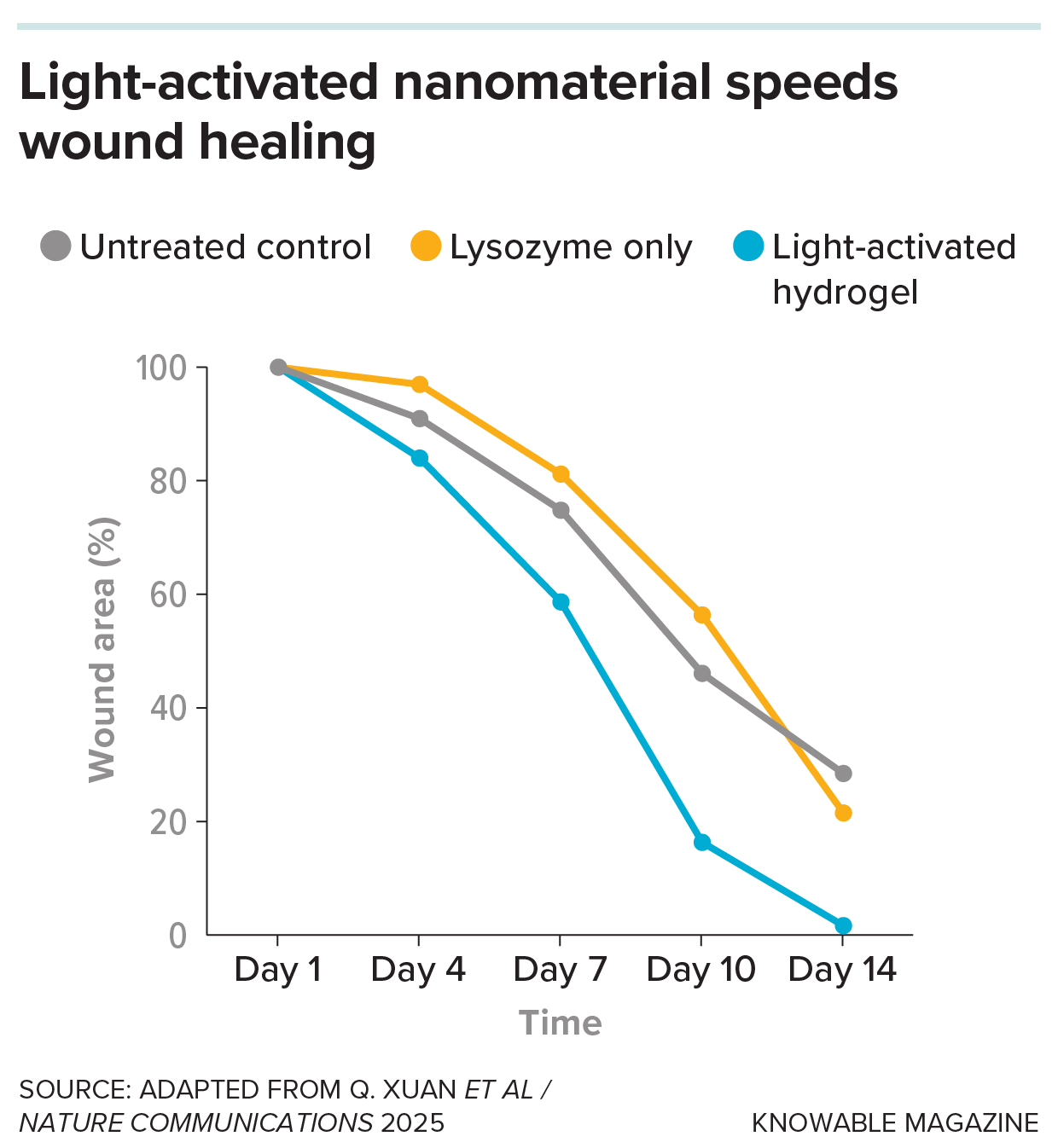
Light-activated nanomaterials that release noxious compounds only when and where they are needed can help eradicate wound infections while preventing damage to unaffected tissues. Here, mice with antibiotic-resistant wound infections were treated with a hydrogel that releases lysozyme, an antibacterial protein, only when activated by light. Their wounds healed more quickly than those of mice left untreated or treated with lysozyme alone.
Since bacterial biofilms are especially persistent on the surfaces of medical implants — where they can cause recurring infections and sometimes require repeated surgeries or even amputations — the team also tested their gel on infected prosthetic joints in mice. They injected the gel around an infected implanted needle and shone near-infrared light through the skin. The treatment cleared biofilms and eradicated about 99 percent of bacteria around the implant, while preserving bone tissue.
In another recent study, scientists from Gannan Medical University and Shanghai University in China treated wounds using a nanomaterial made of gold nanoparticles and graphene-oxide “quantum dots,” which are tiny, carbon-based semiconducting particles. When irradiated with blue light, the gold particles absorb the light energy and convert it into heat, while graphene oxide helps to transfer electrons across the material. This boosts reactions that produce toxic, unstable molecules called reactive oxygen species that react with structures on bacterial membranes and destroy them.
When the scientists added this material to a bacterial solution and shone blue light on it for 10 minutes, the mild heat and reactive oxygen species worked together to cause bacterial membranes to disintegrate. Using a stain that distinguished dead from living bacteria, the researchers confirmed that the treatment had killed 97 percent of the bacteria.
Testing the nanomaterial in mice revealed that after nine days, the wounds on treated mice showed 99 percent healing, while those of untreated mice showed only about 70 percent healing.
While these techniques have shown promise in the lab, further work will be needed before they can be applied to people. “There is still some way to go,” says Lars Kaestner, a biologist at Saarland University in Germany. To be useful in a clinical setting, he notes, researchers would need to do extensive safety testing and lower the cost of the nanomaterials.

Nevertheless, the idea provides hope for patients with chronic wounds that fail to heal with conventional antibiotics, particularly as drug-resistant infections become more common in hospitals and diabetic care.
“It’s a good concept,” says Qin. “Wound healing and antibacterial resistance are very big challenges. And I think any advance that we can make in these areas would be welcome.”
10.1146/knowable-061026-1
TAKE A DEEPER DIVE | Explore Related Scholarly Articles
More From