
When sunlight hits an octopus, it can trigger a swift color change and instant camouflage, thanks to light-sensitive molecules embedded in the creature’s skin. When sunlight falls on a bird’s skull, similar compounds deep in the animal’s brain register changes in day length and help drive decisions on when to mate or migrate.
Photosensitive proteins called opsins that respond instantly to sunlight can be found within and outside the eye in nearly every animal, and they govern not only vision but also a range of behaviors. Until about a quarter-century ago, though, the scientific consensus was that in humans, the only role for opsins was to help us see.
But a surge of research over the past couple of decades has increasingly revealed that, like honeybees, zebra fish, rodents and other creatures, we harbor opsins that aren’t involved in vision, both in our eyes and throughout our bodies. These molecules appear to play a broad role in human biology, affecting mood, metabolism, sleep, thinking and social behavior.
Since life’s beginnings, organisms on this sunbaked planet have had to evolve ways to protect against ultraviolet light, which can damage DNA. But it shouldn’t be surprising that, as dangerous as sunlight can be, most animals also rely on it to regulate key aspects of physiology, including body temperature, navigation, growth and sexual development.
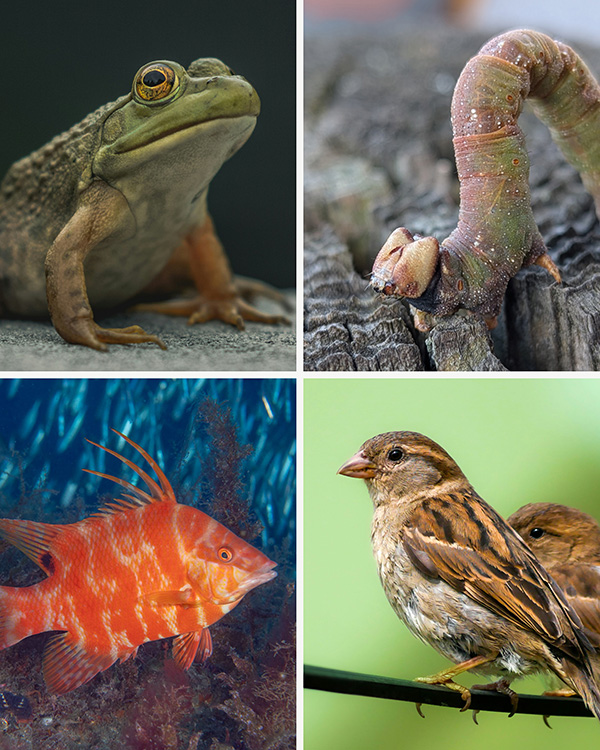
Across the animal kingdom, researchers are discovering that light-sensing opsins are involved in an array of biological processes beyond vision. These include camouflage; sensing seasonal changes via lengthening or shortening day lengths; synchronizing with the 24-hour cycle — as well as mood, healing and more. (From top left, clockwise: frog, moth larva, sparrow and hogfish.)
CREDITS CLOCKWISE FROM TOP LEFT: ADAM CURRIE/UNSPLASH, RICHARD DUBOISY/iNATURALIST, SOPHIE LEGTENBERG/UNSPLASH, FRANK KRASOVEC/iNATURALIST
“Photobiology is this huge thing, because light affects everything on the planet, almost, except for deep cave fish,” says David Berson, a visual neuroscientist at Brown University in Providence, Rhode Island.
The light-sensitive cells within the human retina that send signals to the brain, facilitating vision, are well known. Cone cells respond to various color wavelengths, and rod cells enable us to distinguish our surroundings in low light. Embedded in both are distinctive proteins — the visual opsins — that enable these cells to operate.
But now scientists are investigating three other light-reactive proteins in the human body. These molecules — melanopsin, encephalopsin and neuropsin (the “three sisters,” as one researcher calls them) — are found, variously, in the retina, the brain, the skin, the immune system and blood vessels. Two in particular are still not well understood, and scientists differ in their interpretations of the early research findings, but consensus is emerging that light-driven biological pathways contribute to human health in multiple ways. Strong evidence suggests that nonvisual opsins affect mood regulation and our daily biological rhythms, and preliminary studies implicate them in a range of potential other processes, including fat storage and metabolism and proper eyesight development.
“I think now we’re beginning to appreciate more and more that light has an effect on many, many forms of behavior and physiology that are independent of vision,” says biologist Iggy Provencio of the University of Virginia.
An unlikely light clicks on
In 1998, Provencio and colleagues discovered one of the three nonvisual light-sensitive proteins, melanopsin. Long before it was found and named, it already had a reputation, its existence predicted by a few experts but derided by most. A light-dependent molecule within the eye that wasn’t for sight? “We would joke that we could locate our posters [at a] conference just by listening for the laughter,” Provencio recalls.
Yet there were tantalizing clues. Many people with total blindness lose the ability to align their body clock to Earth’s day/night cycle, so scientists knew that this synchronization, which is critical to maintaining good health, involved the eyes. Meanwhile, circadian scientists including Russell Foster, now at the University of Oxford, found that mice lacking the rods and cones necessary for vision could still coordinate their daily activities with planetary rhythms. When their eyes were removed, however, they couldn’t. The conclusion: There must be an unknown photoreactive sensor in the eye that registers the presence and quantity of light to convey time-of-day information to the brain, but that has nothing to do with vision.
Melanopsin turned out to be that sensor. And then Provencio made another discovery. In 2002, his team developed an antibody that reacts with melanopsin and applied it to a flattened mouse retina under the microscope. They hoped to learn where melanopsin was located and how much of it there was, but had no idea what they would see. What came into view was a ghostly lattice-like pattern — what Provencio would later describe as a “photoreceptive net” — revealing how thoroughly melanopsin is interwoven into the structure of the eye. He turned to his colleague and said, “You realize we are the first people in the world looking at a novel sensory system in mammals?” he recalls. “It was thrilling.”
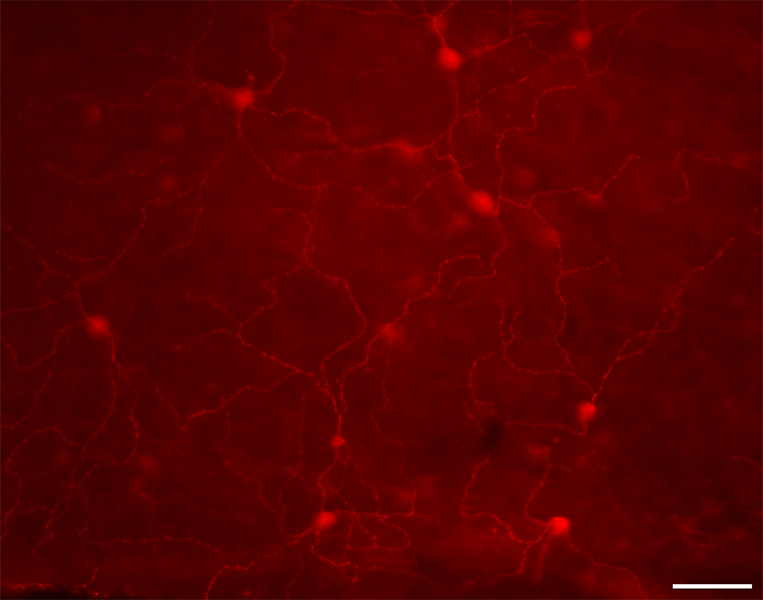
The eye contains a light-sensitive protein called melanopsin that is not involved in vision. Instead, it helps to keep our bodies in sync with the 24-hour day, through sensing light then sending signals to a master clock in the brain. Biologist Iggy Provencio of the University of Virginia, a co-discoverer of melanopsin, created this light microscope image, which shows the broad distribution of melanopsin in the retina of a mouse.
CREDIT: IGGY PROVENCIO
Since then, other scientists have discovered that melanopsin does much more than help set our body clock. Rodent research led by neuroscientist Samer Hattar at the National Institute of Mental Health reveals that melanopsin-containing cells in the retina send light-based signals all over the brain, not just to the master timekeeper. Through these pathways, light hitting the eye communicates directly with brain regions such as the hypothalamus, where it affects learning and sleepiness, and the perihabenular nucleus, where it influences mood regulation. This means that daylight exerts a potent biological influence. In its presence, we tend to feel happier and be more alert and cognitively sharper, Hattar says. These effects may explain why homes that are naturally bright tend to be more desirable, Berson says.
Unlike melanopsin, which explained an unsolved scientific question — how sunlight sets our body clock — the other two nonvisual light-activated proteins in humans were, simply, odd. Discovered by scientists combing through the genome, they possessed the distinctive opsin molecular structure, but for the longest time no one had any idea whether they had a purpose or if they were just evolutionary leftovers.
Not enough time outside
But evidence is emerging about the roles of these two molecules, neuropsin and encephalopsin. One relatively well-established function for both involves healthy eye development. Research suggests that, along with exposure to adequate distance vision, stimulation by the violet wavelengths often missing from indoor lighting may help children’s eyeballs develop properly into spherical eyes and not the oval shape that creates nearsightedness.
“Now kids spend a lot of time in front of the computer, not so much outside,” says cell biologist Elena Oancea of Brown University, coauthor of a 2026 overview of nonvisual opsins in the Annual Review of Physiology. Globally, myopia rates are rising fast. Studies show that time outdoors is preventive; China is combatting its myopia epidemic by mandating that schoolchildren spend significant stretches of time outside.

The recently discovered light-sensing proteins neuropsin and encephalopsin may have a role — along with inadequate time looking into the distance — in helping the eye develop correctly. In myopia (short-sightedness), the eyeball develops into an oval shape instead of a spherical one. To combat growing rates of myopia, China has mandated that schoolchildren spend more time outdoors. Here, schoolchildren are having a lesson outside of the classroom.
CREDIT: © NINGLI WANG / CC BY-NC 4.0
Neuropsin may also help wounds heal. In a recent study, molecular biologist Ethan Buhr of the University of Washington, Seattle, and colleagues found an increase in neuropsin along with accelerated healing after damage to a mouse’s cornea — and saw that when mice were modified to lack neuropsin, their corneas healed much more slowly.
Buhr thinks neuropsin assists healing by tamping down cell growth at times of day when ultraviolet light could damage the vulnerable new tissue, then accelerating healing during darkness. His latest research, not yet published, suggests that the same mechanism is at work in the skin, where neuropsin seems to keep track of when the Sun is out in order to mobilize protection from UV rays.
There are other intriguing but tentative findings, such as encephalopsin’s possible role in regulating metabolism, in at least two ways. New research suggests that sunlight passes through skin, causing breakdown in the layer of fat underneath. Work by multiple labs indicates that encephalopsin, which is present in fat and activated by blue light, may be a key part of the mechanism that initiates turning the fat into usable energy.
In another recent study, Oancea, with Richard Lang, codirector of the Science of Light Center at Cincinnati Children’s Hospital, and colleagues, discovered that in mice, encephalopsin inhibits a brain signal that regulates appetite, causing animals to seek food.
All these metabolic, mood and alertness impacts of light exposure make sense from an evolutionary standpoint, scientists say. In premodern times, when humans lived outside, our active phase began at dawn. Nonvisual opsins activate as soon as the Sun rises, triggering subtle changes that prime us physically and mentally for the exertions of the day.
These light-activated biological sensors may also help to explain why light boxes relieve wintertime depression. The mechanism of action may be melanopsin communicating with mood centers in the brain, Lang says.

Concerns about skin cancer have made the Sun our enemy, but the science of nonvisual opsins, and a growing appreciation of the primordial benefits they confer, suggests that we need to spend more time in natural light. “In so many ways, we saunter through our built environments with our electric lights and think it’s going to be fine,” Berson says. “But we’re making ourselves sick.”
Hattar and other opsin researchers suggest venturing outside without sunglasses or sunscreen for about 15 minutes a day at least (to avoid sun damage, you can go out in the early morning or stay in the shade). Receiving sunlight through our eyes lifts our mood and helps us think more clearly. And counterintuitive though it sounds, tentative evidence suggests that sunlight hitting our bodies activates the DNA repair mechanisms that keep skin healthy. “You don’t want to overdo it,” Lang cautions, but “getting a little bit of exposure is probably a good thing.”