

LAYOUT MENU

Slums are bearing the brunt of the climate crisis — and devising solutions
As temperatures rise, it is the poor who suffer most. The coping strategies of those living in informal settlements may hold lessons for cities of the future.
Support sound science and smart stories
Help us make scientific knowledge accessible to all
Donate today
Reporting for this story was supported by the Pulitzer Center.
Since moving into a public housing project in Mumbai nearly 20 years ago, Parveen Shaikh has grown familiar with the ravages of extreme heat. She has acquired a new vocabulary, adding terms like “low blood pressure” — which she has learned is a consequence of blood vessels dilating to keep the body cool and causes dizziness, vomiting and irritability. “Little kids,” she observes, “get angry faster than they used to.”
Shaikh doesn’t remember low blood pressure being a problem when she was growing up in poverty on the city’s sidewalks, though there were plenty of others. It was a victory of sorts when she moved into her home as part of a government relocation program. But as India’s seasons have become less predictable, and its hot periods hotter, the flaws in the housing project’s construction have become apparent.
There isn’t much space between the tenements here, and many apartments lack natural light and ventilation. The heat, when it arrives, is inescapable, as are its physiological consequences. On the day in late January when I met Shaikh, summer was more than a month away, but a team of medics was already testing people’s blood pressure in the shade of a residential block.
Heat is now a major and growing problem across the Global South. Under the highest emissions trajectory, rising temperatures will cause an additional 6 million deaths per year by 2100, according to estimates from the University of Chicago’s Climate Impact Lab. That’s comparable to today’s annual deaths from infectious diseases. The vast majority of those deaths will happen in the poorest countries, where the most vulnerable of all are those who live or work informally — those who make their homes in slums or on the street, or who are employed in the gig economy.
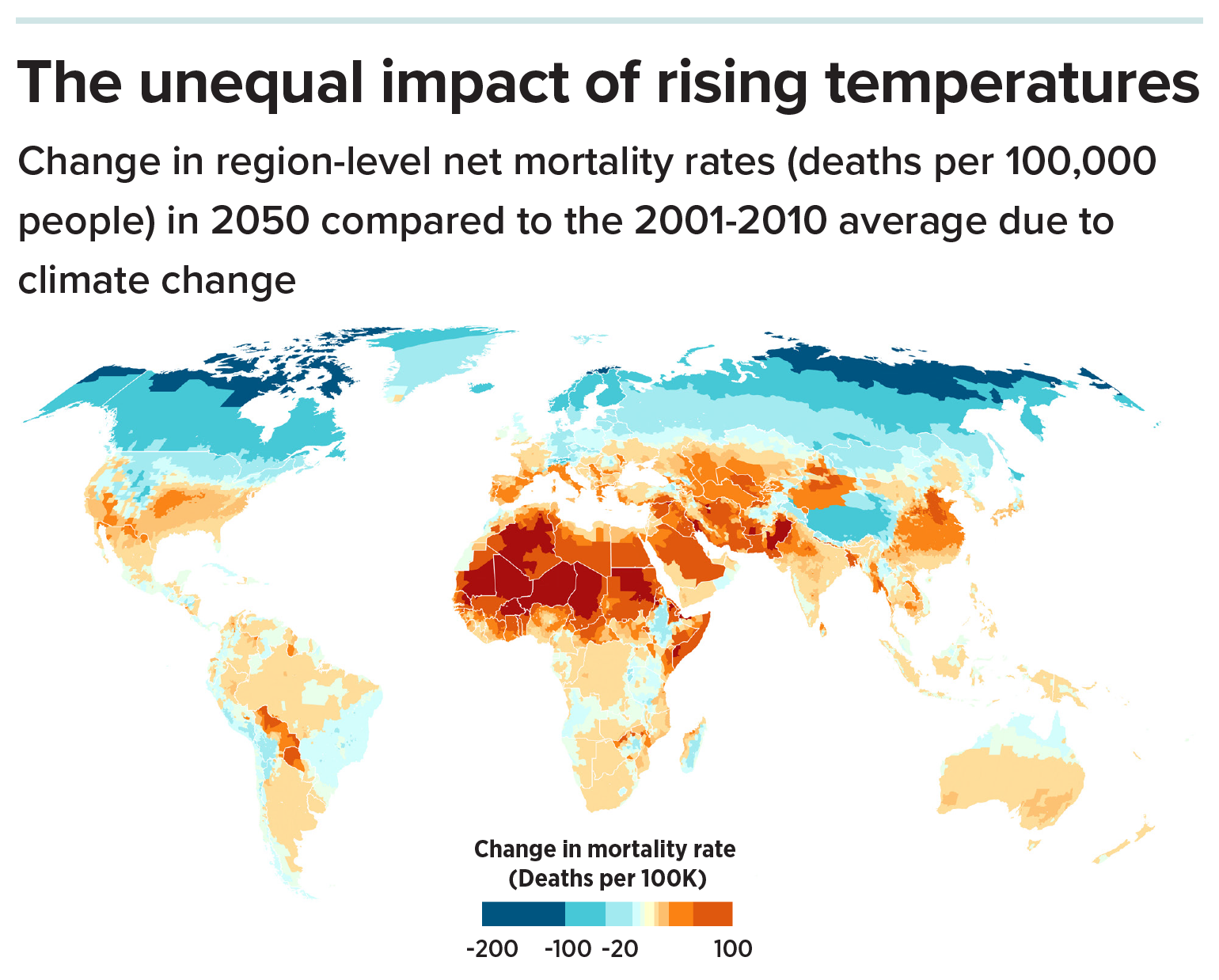
The likelihood of dying from climate change-related heat depends on location: More deaths are projected for lower-latitude regions such as Northern Africa, the Middle East and Southwest Asia, while fewer deaths are projected for the globe’s mid-to-high latitudes.
CREDIT: HUMAN HEALTH: MEASURING THE IMPACT OF RISING TEMPERATURES ON MORTALITY TO TARGET ADAPTATION PLANNING / CLIMATE IMPACT LAB, MARCH 2026. FULL REPORT
Indeed, climate change “is already profoundly affecting the lives of poor people worldwide — A, because they live in places that are already hot, and B, because they are not able to protect themselves as well,” the Nobel Prize-winning economist Esther Duflo of the Massachusetts Institute of Technology and the Collège de France told me at the Jaipur Literature Festival in India in January.
Duflo, coauthor of the book Poor Economics, whose second edition addresses climate change, sees a vicious cycle at work: Climate change pushes more and more people off the land as that land becomes increasingly uncultivable, and exposes them to a new set of risks in the cities to which they gravitate.
“There is no way to think about how to cope with climate change that doesn’t put the poor at the very center of the conversation,” Duflo says.
So far that conversation has ignored the poor, with the result that cities are ill prepared to undertake the massive infrastructure projects needed to accommodate an accelerating influx of people, says Duflo. That’s especially true in the Global South, which is the fastest urbanizing region and where most of the growth is informal — meaning that it is uncoordinated and happening outside of any legal framework. But it won’t be long before all urbanites — who already account for more than half of humanity — feel the strain.
Yet precisely because it has been the first to inhabit the climate crisis, the Global South has also been generating the first, albeit ad hoc, solutions. Heat, flooding and a surge in infectious diseases are forcing the poor, in particular, to be creative to survive. They are finding ways to keep cool and dry, building resilience from the bottom up — largely without the help of official institutions.
It’s a piecemeal resilience for now, but others are learning from their solutions, and in some cases scaling them up. Researchers are even realizing that despite being marginalized, informal settlements may have structural advantages over formal ones, since many of them combine high density and strong social and economic networks with a relatively small carbon footprint.
A new ethos is emerging — that informal urban growth may not just be inevitable but also may hold lessons in resilience for the cities of the future.
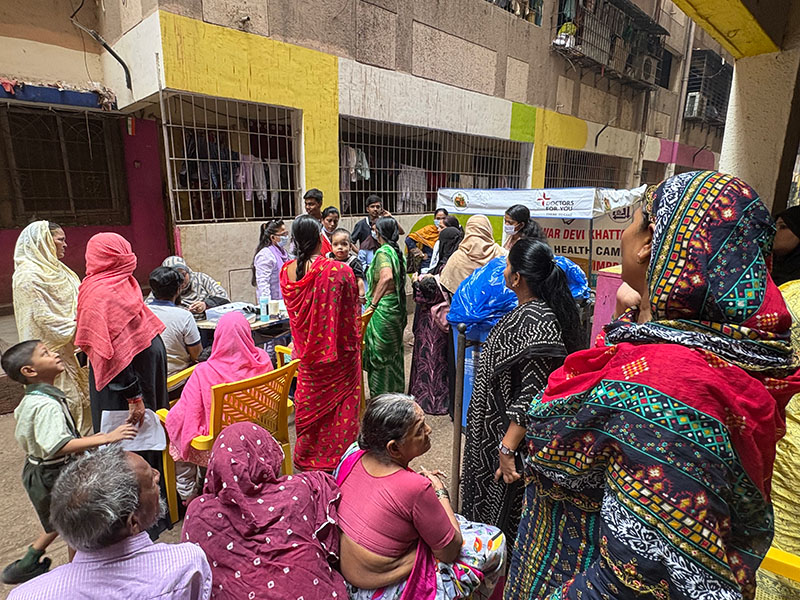
Medics test residents’ blood pressure at a housing project in Mumbai, India
CREDIT: LAURA SPINNEY
Mapping heat and health
Slums were long shown as “blank spots” on the world’s maps, UN-Habitat noted in 2003. Partly due to satellite and drone technology, and partly thanks to efforts by informal communities to map themselves, that is no longer true.
As the informal city swam into view, so did the negative effects of climate change on the urban poor. Now researchers are systematically studying those effects, to understand which solutions will bring the greatest benefits.
For example, in an ongoing study run by Indian grassroots organizations in collaboration with Harvard University, female tenant farmers and piece-rate workers received Fitbits to wear, and environmental sensors were fitted in their homes and workplaces to monitor the heat and humidity there. They showed that these people literally have no place to hide.
At the peak of summer, those who work outside, which is the majority, are exposed to near-intolerable temperatures — 35 degrees Celsius (95 degrees Fahrenheit) and higher. “Even the water gets so hot that we feel that we are having tea,” said Subhiben, a study participant from Gujarat who works raking brine in the region’s enormous salt flats. And often, the sensor data show, the heat doesn’t let up when they return home.
Among the negative health outcomes that these women report are cardiac stress, gynecological problems including miscarriage, and mental health issues, says Sahil Hebbar, a doctor with the Self Employed Women’s Association (SEWA) in the Gujarati city of Ahmedabad and one of the coordinators of the study.
The research is revealing unsuspected interactions too, including between heat and malnutrition. According to Hebbar, up to half of SEWA’s members suffer from anemia, which can be caused by iron deficiency. That anemia correlates with much poorer cardiovascular outcomes in response to extreme heat, according to an as-yet unpublished finding of the study.
Other researchers are documenting the infectious diseases spreading in informal settlements, helped along by crowding and inadequate ventilation. Tuberculosis remains endemic in India where, according to the World Health Organization, two deaths from TB occur every three minutes. It is a major problem at Shaikh’s housing project, as it is at many others across the country.
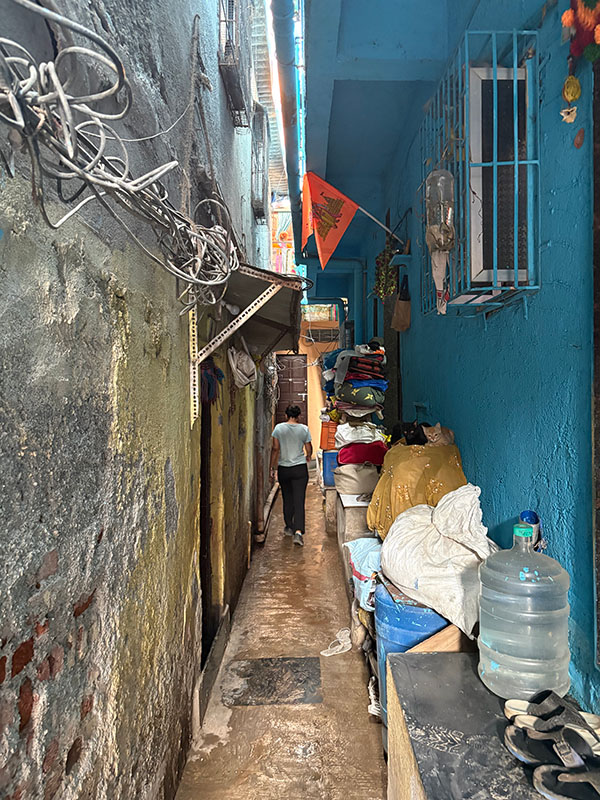
An alleyway in Dharavi, an informal settlement in Mumbai, India
CREDIT: LAURA SPINNEY
The situation is reminiscent of the disease-ridden slums of New York, London and other northern cities in the early 20th century, except that today the disease is preventable. “We have the tools to diagnose and treat 100 percent of people with TB,” says Guy Marks, a respiratory physician at the University of New South Wales in Sydney and president of the International Union Against Tuberculosis and Lung Disease.
Cholera and other waterborne diseases typically surge in the wake of floods, and a 2025 study showed that one in three informal settlers in the Global South live in floodplains and are at risk of a “disastrous flood.” But such diseases are now a problem outside of floods, too. Meanwhile, vector-borne diseases, such as those carried by mosquitoes, are on the rise. Health geographer Olivier Telle of the CNRS in Paris reports that dengue, which is transmitted by the Aedes aegypti mosquito, is thriving in informal settlements where heat is increasing and people stock water because they don’t have access to a running source — providing ideal conditions for mosquitoes to breed.
And rather than staying in these settlements, which are often on the edges of cities, dengue is creeping toward the city centers, following human mobility and employment opportunities. Telle’s team found that in Delhi, for example, the wealthiest neighborhoods had an incidence of dengue similar to impoverished ones, probably because more infected people from the periphery worked there. “You need to protect the least well-off to protect the community as a whole,” Telle says.
Cooling begins at home
As data on climate-driven health problems accumulate, researchers are beginning to discern which grassroots solutions are most protective. One of the most effective ways to protect workers from extreme heat is to ensure that they can keep their homes cool, the India-Harvard study found. Simply painting a roof with white reflective paint, for example, can reduce indoor temperatures in summer by around 2 degrees Celsius. Since WHO estimates that more than half of the urban housing stock that India will need by 2070 has yet to be built, Hebbar hopes that such simple fixes will feed into that future formal development, producing more climate-adapted homes and workplaces.
Others are thinking along similar lines. Mumbai-based Sheela Patel, former chair of the grassroots federation Slum Dwellers International, is leading a project called Roof Over Our Heads (ROOH) in which slum dwellers — mainly women — collaborate with architects and engineers to build climate-resilient, affordable homes. One ROOH house I visited under construction in Mumbai had floor tiles made of plastic collected by informal garbage collectors and recycled. It was about to receive a roof of pre-painted galvanized iron sheeting, which reflects heat.
To date ROOH has built around 250 houses in a dozen countries, and Patel’s hope is that seeing these, other slum dwellers will borrow elements or copy them entirely. The project’s aim is to bring together broadly applicable solutions in a single place, eventually a web-based platform, so that people all over the Global South can access them and adapt them as needed. For her, it’s critical that the solutions come from the people closest to the problem, so that when the authorities finally decide to act, those solutions — tried and tested — will be waiting for them.
Others are devising plans for retrofitting whole settlements to make them more climate-resilient — the kind of solution that needs to be implemented top down, by city or state authorities. In Nairobi, Kenya, for example, a low-cost scheme to connect residents of the informal settlement Mukuru to the city’s sewage system has been put in place. This “simplified sewer,” which uses smaller pipes and shallower excavation, has already led to a significant drop in cholera , even though it’s only partially complete.
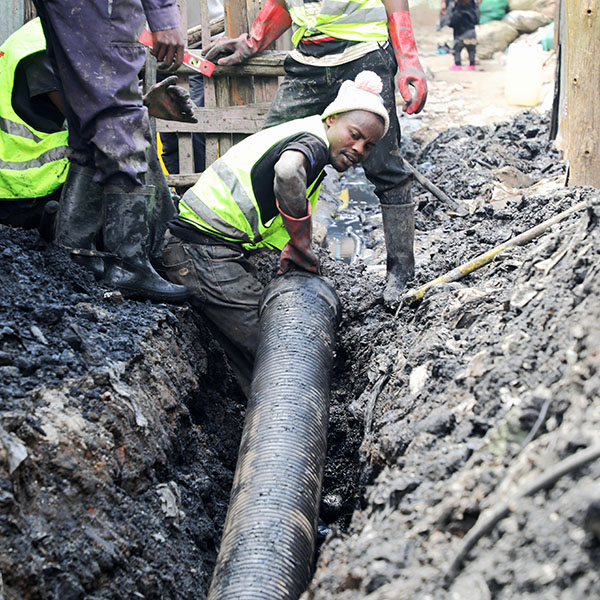
In an informal settlement in Nairobi, Kenya, people install a simplified sewer. These smaller pipes will connect residents of dense communities to the larger main sewer lines.
CREDIT: COURTESY OF AKIBA MASHINANI TRUST
Such in situ upgrading is generally considered the gold standard for improving slums, because inhabitants stay put and their social and economic connections are preserved. But it isn’t always possible, according to urbanist José Núñez Collado of Victoria University of Wellington, New Zealand. For some informal settlements, relocation of the entire community is the best or only option — and that will be true more often, he says, as the climate crisis intensifies.
For now, such relocations tend to happen without much consultation with the inhabitants. This was the case, for example, with La Barquita — a flood-prone informal settlement in Santo Domingo in the Dominican Republic, whose inhabitants were relocated to a social housing project in 2016. Collado’s decade-long study of that relocated community shows that they feel more secure in their new home, La Nueva Barquita, but that many people have either lost their jobs or must now travel farther to work.
Projects like India’s ROOH are attempts to stimulate a more collaborative approach to improving informal settlements — one that combines bottom-up and top-down initiatives, taking account of the needs and expertise of their inhabitants. For ROOH’s Patel, such an approach is long overdue. “We believe that extreme weather is going to impact 2 billion people living informally in the future, a quarter of the global population,” she says. “No government, no industry, is looking at this.”

What is clear is that the informal city can’t be eliminated. As more data accrue, researchers like complex systems scientist and urbanist Luís Bettencourt of the University of Chicago are using it to show that informal settlements emerge in fast-growing cities as a bottom-up measure by which people build housing in the absence of adequate supply. “They provide a pathway to development,” he says.
Given this, Bettencourt thinks that governments should be working with the urban poor, not only to retrofit informal settlements, but also to plan prospectively — making sure that future cities are fit for habitation, and not just by the rich. His research, which builds on half a century of efforts by informal communities to map and survey themselves, has revealed one principle that he feels should guide all future policy. He distills it into two words: “Informal’s normal.”
10.1146/knowable-060926-2
TAKE A DEEPER DIVE | Explore Related Scholarly Articles
More From